







It's 410km south of Okinawa Island, about a 1-hour flight away.
Ishigaki Island is located in the Yaeyama Islands, the southernmost islands of Japan.
This page provides a map of Ishigaki Island and its surrounding islands, along with information on the climate and transportation options within the island.
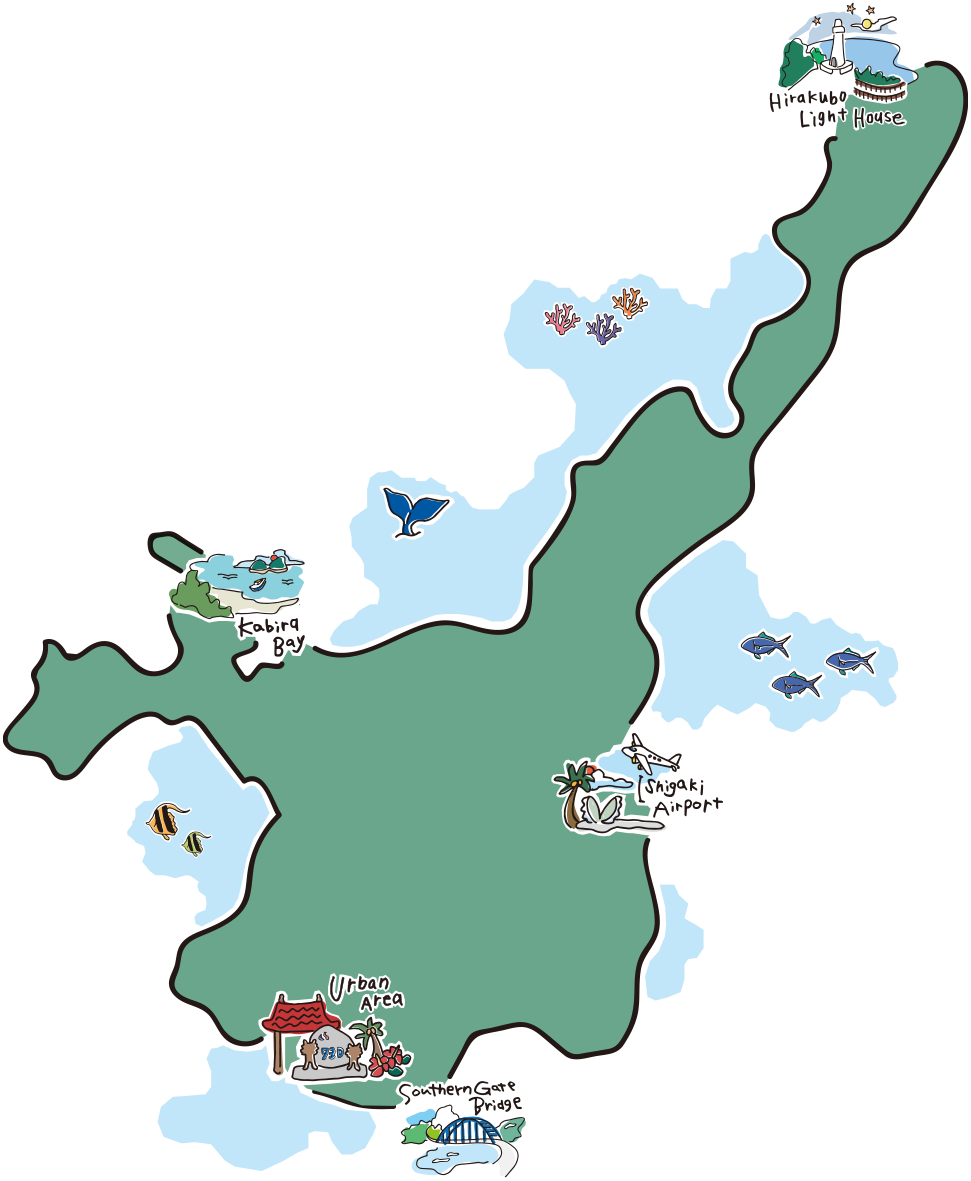
Ishigaki Island Map
Ishigaki Island, the gateway to the Yaeyama Islands, is a naturally rich island surrounded by coral reefs and dotted with mountains.
The town is compactly located on the southern side of the island, surrounded by sugarcane fields, pineapple farms, and pastures where cows graze peacefully.

The town center, which has many restaurants and souvenir shops, faces the sea on the south side of the island. The ferry terminal for the outlying islands is also located right next to the town center.
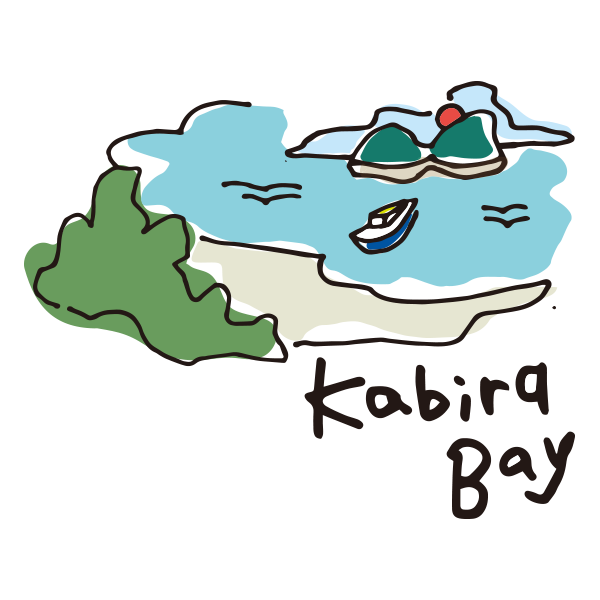
Kabira Bay is one of the island's most representative scenic spots. It's a place I highly recommend visiting for anyone visiting Ishigaki Island for the first time.

The northernmost point of the island with the lighthouse. The unobstructed panoramic view of the sea is beautiful.
The gateway to the Yaeyama Islands is Painushima Ishigaki Airport. The current airport is a new one that opened in 2013. It's about a 30-minute drive from the city center.
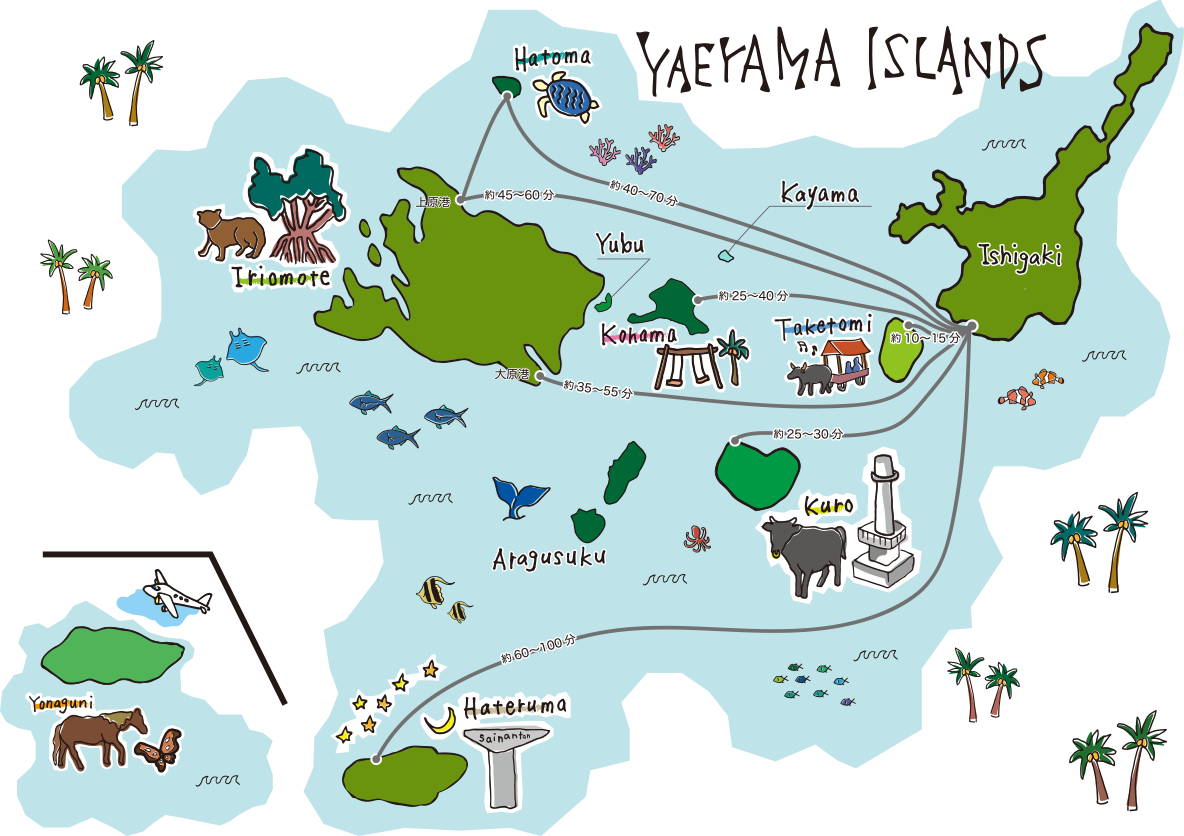
Yaeyama Map
There are many unique islands surrounding Ishigaki Island. Boats to nearby islands depart from the Euglena Ishigaki Island Ferry Terminal, located south of the city center.
Check the shipping company's website for departure schedules!
An'ei Kanko
Yaeyama Sightseeing Ferry
Click here for more information about the remote island terminal!
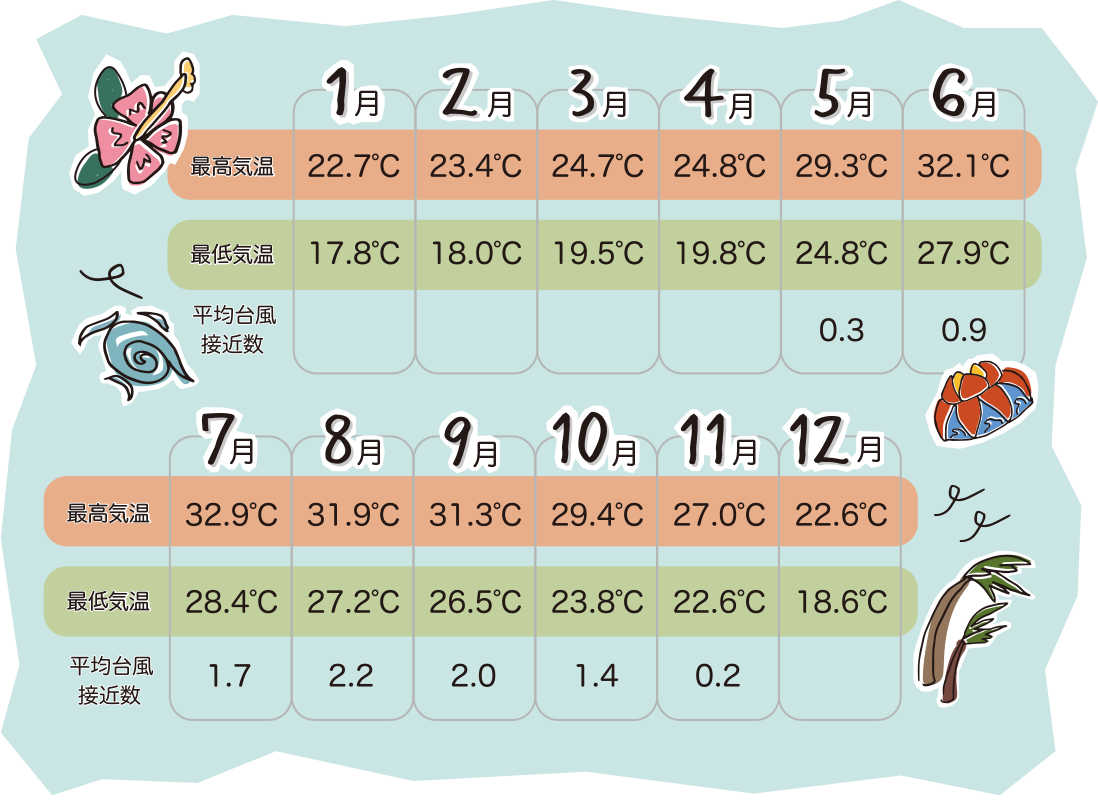
Ishigaki Island's climate, typhoons
Ishigaki Island, which has a subtropical oceanic climate, enjoys a warm climate throughout the year.
The typhoon season runs from around May to November. While it's mostly sunny during the summer, there are also many sudden, short showers like squalls.
From December to around March, winter weather tends to be gloomy. The sea breeze is also strong in winter, making the perceived temperature slightly lower than the actual temperature.
*Temperature data is from the Japan Meteorological Agency, 2020. Typhoon data is the average number of typhoons that entered within 300km of the Ishigaki Island Meteorological Observatory from 2011 to 2020.
My outfit was like this.
Spring (March to May)![]() |
It's getting warmer, but there are still some chilly days with northerly winds, so it's a good idea to have long sleeves. From around the beginning of May, temperatures will reach nearly 30℃. May is the rainy season, but it's not the kind of rainy season with continuous drizzle like on the mainland; there are sunny days as well. |
|---|---|
Summer (June to August)![]() |

We'll have several days of temperatures above 30°C. It's a good idea to bring a light jacket or cardigan indoors, as the air conditioning will be on and the UV rays will be very strong. Don't forget your hat and sunglasses. There will be sudden, heavy downpours. |
Autumn (September to November)![]() |

It's hot during the day, but from around October it gets cooler in the mornings and evenings, so you'll need long sleeves. Until the beginning of November, daytime temperatures can reach 30°C, so you can swim in the sea or pool. |
Winter (December to February)![]() |

It gets suddenly cold in December. The sea breeze is strong, making the perceived temperature a little lower than the actual temperature, so you'll need to wear warm clothing such as a jacket or light coat. However, it can get hot when it's sunny, so it's best to have layers you can easily take off. |

How to get to Ishigaki Island
Currently, Ishigaki Island is only accessible by air. Direct flights are available from major cities.
Connecting flights in Naha are also convenient, with JAL and ANA flights taking approximately one hour to Ishigaki Airport.
Ishigaki Island, located along the east coast of the island, offers spectacular views during takeoffs and landings.
From Haneda Airport
Direct flights with JAL and ANA take approximately 3 hours and 10 minutes.
From Narita Airport
Approximately 4 hours by direct flight with Peach Aviation.
From Kansai International Airport
Direct flights on JAL and ANA take approximately 2 hours and 25 minutes.
Approximately 2 hours and 45 minutes by direct flight with Peach Aviation.
From Nagoya Airport and Fukuoka Airport
Direct flights are available depending on the season.
Click here for more information about the airport!
Movement within the island
Rental car
There are many car rental companies. If you want to get around the island efficiently, renting a car is definitely the best option.
taxi
Taxis are readily available at airports, island ferry terminals, shopping districts, and large hotels, making travel convenient. Some taxi companies even offer full-day sightseeing tours.
Route bus
Buses run between the airport and the city center approximately every 20-30 minutes, but other routes have infrequent service, so please be aware of that. There is an Azuma Transport bus terminal near the Euglena Island Terminal in the city center.
Bicycle rental
For getting around the compact town, a bicycle is perfectly sufficient. In addition to rental shops, some hotels and guesthouses also offer bicycle rentals.
Rental motorcycle
Rental bikes offer greater maneuverability than cars, making them ideal for active travel. They're available for single riders, and some even accommodate two people.
Electric kick scooter
Electric kick scooters have emerged as a new mode of transportation. They can be driven with a driver's license equivalent to or higher than a moped license.
For more information on getting around the island, click here!
Important information for sightseeing in Ishigaki Island

The sunlight is very strongTherefore, please make sure to take proper precautions against UV rays, such as wearing a hat, a light jacket, and sunglasses.
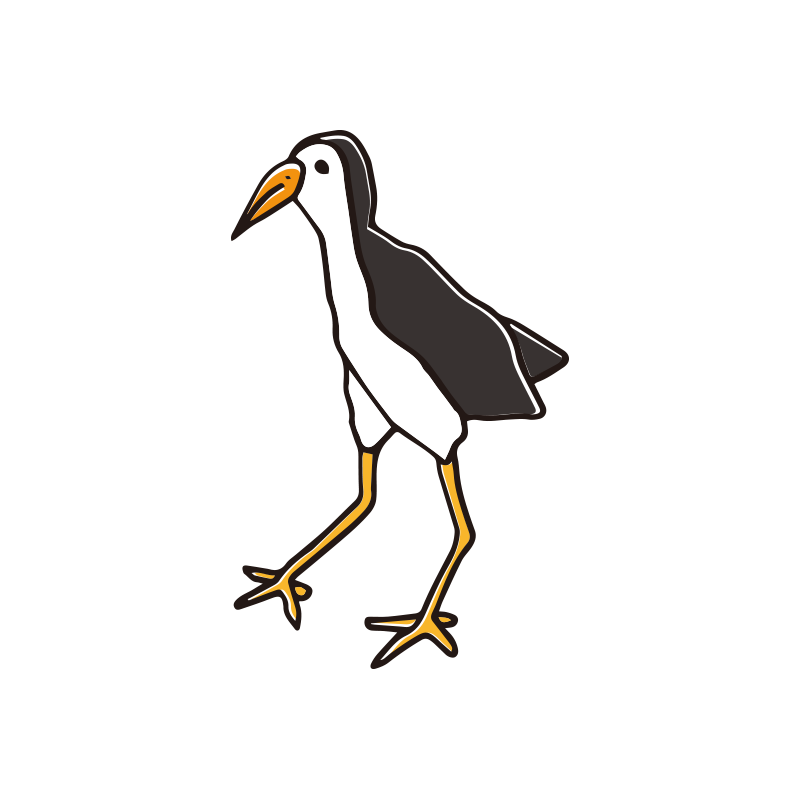
While driving on the road,Wild animals jump outPlease be careful not to speed, as White-breasted Waterhens often suddenly appear in the area.

When a typhoon approaches,Do not go outside while a storm warning is in effect.Let's wait for the typhoon to pass.

Do not swim alone in the ocean where there are no lifeguards or monitors.Please do so. Even if you are confident in your swimming abilities, always swim with someone else.
The waters around Ishigaki IslandThere are many places where rip currents occur.Strong currents have been observed, particularly at Yonehara Beach and Yoshihara Beach. If you feel yourself being swept out to sea, swim parallel to the beach, and once you no longer feel the current flowing out to sea, head towards the shore.

From May to around October,Highly venomous box jellyfish and Portuguese man-of-war have appeared.Yes. Swimming should be done at beaches with jellyfish prevention nets. There are also other dangerous marine creatures, such as crown-of-thorns starfish and lionfish, that can cause inflammation and pain upon contact. For more information about dangerous marine life, please see below.Here。
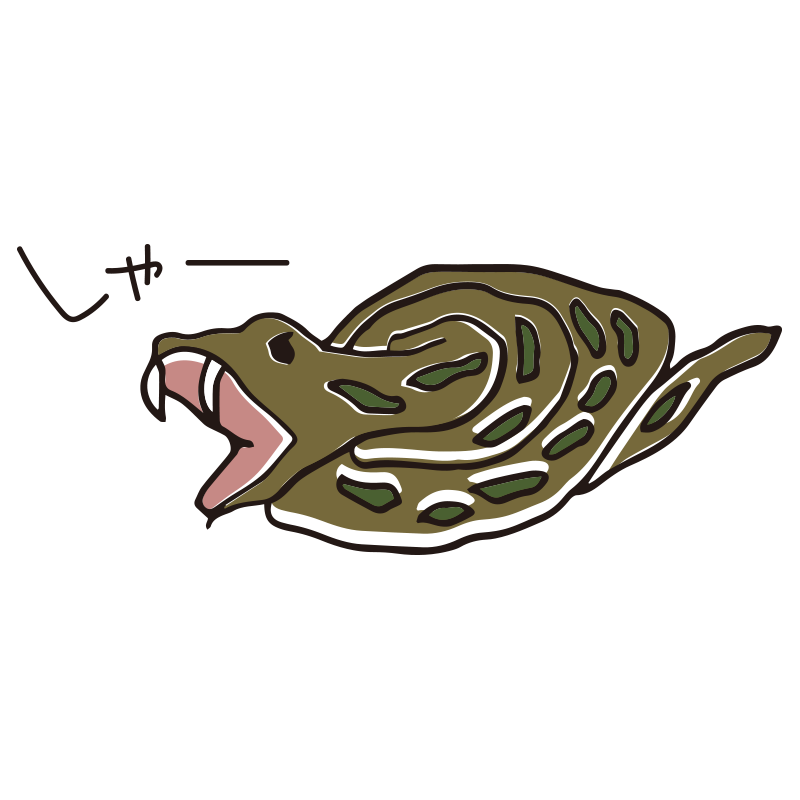
In nature,Beware of the venomous habu snake.Please be careful. Occasionally, they can be found on stone walls of private homes, etc. If you are bitten, call for help and go to the hospital immediately.

The collection and removal of plants and animals is prohibited.

Located in various places on the islandOntake is a sacred place.Please do not enter unnecessarily.